
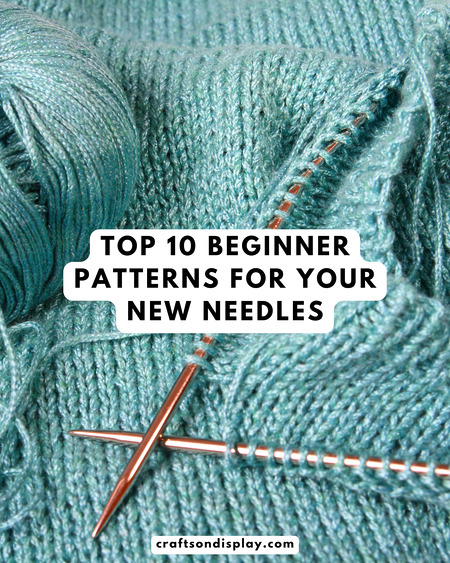
Welcome to the exciting world of knitting for beginners! Perhaps you received a beautiful beginner knitting kit over the holidays or you’re looking for a calming new hobby. Whatever inspired you, you deserve easy knitting patterns that are satisfying and quick to complete.
You can totally make cool stuff right away. Here, we’re going to focus on simple shapes that build your confidence in the basics. Pick up your new needles and let’s get started!
Your First 10 confident Projects
These beginner-friendly knitting patterns focus on the two foundational moves – the knit stitch (K) and the purl stitch (P). Mastering these shapes is the best way to learn how to knit anything!
#1 The Dishcloth
This is truly the ultimate starting point. It requires only a small amount of yarn, which is perfect for using up scraps or just practicing your tension. Since it’s a household item, any small mistakes you make are completely forgiven. You can even practice a textured stitch pattern, like Moss Stitch, to see how knits and purls work together.
Free Pattern Links:
#2 Easy Rectangle Scarf
A scarf or cowl is a brilliant exercise in consistency. For a scarf, you simply knit until it is long enough. If you want a quick finish, use a thick, bulky-weight yarn. A cowl is just a shorter scarf you seam into a loop! You can practice the Garter stitch (knit every row) for a bumpy, reversible fabric.
Free Pattern Links:
#3 Basic Hat (Knit Flat)
Yes, you absolutely can knit a cozy beanie without juggling circular or double-pointed needles! This method involves knitting a simple rectangle on straight needles. You then sew the two sides together to form a tube, and gather the top edge to create the crown shaping. It’s a great introduction to garment construction.
Free Pattern Links:
#4 Mug Cozy
These tiny projects are perfect for dipping your toes into minor shaping techniques. Most mug cozies are a flat strip, but they often require you to knit a small buttonhole or work a simple decrease. They are quick, cute, and make wonderful little gifts.
Free Pattern Links:
- Knit Your Own Mug Cozy (Snapdragon Life)
- Simple Cabled Mug Cozy (Flat)
#5 Pillow Cover Panel
For a larger, impactful home project, try knitting one panel for a decorative throw pillow. It’s essentially a very large square, meaning you’ll practice consistent tension across a wider fabric. You can use a textured stitch like Basketweave to add a professional touch before sewing it onto a pre-made cushion.
Free Pattern Links:
#6 Fingerless Gloves
Don’t let the thought of gloves intimidate you! Most beginner fingerless mitts are knit as a flat rectangle. You simply leave a gap when seaming the piece to create the thumb hole. This project introduces you to working slightly smaller items and finishing seams.
Free Pattern Links:
#7 The Simple Headband/Earwarmer
This is a satisfyingly fast project that uses minimal yarn. Because it is small, you can try out a slightly more complex stitch, like a simple 1×1 or 2×2 rib, which makes the fabric extremely stretchy so it fits snugly around your head. It’s an instant gratification knit!
Free Pattern Links:
#8 Little Bookmarks
If you need a project you can finish in an hour or two, try a bookmark. You will cast on a very small number of stitches. The entire focus is practicing your cast-on, knit/purl rows, and bind-off perfectly. Add a tassel when you are done for a polished look.
Free Pattern Links:
#9 Garter Stitch Baby Blanket
This is a classic beginner project that results in a beautiful, cushiony heirloom. The garter stitch texture is the same on both sides and doesn’t roll or curl. While it takes time, the repetitive knit motion is incredibly soothing and excellent for building muscle memory.
Free Pattern Links:
#10 Your Dream Project Swatch
Do not knit dozens of things you don’t love. Your goal is the project that made you pick up the needles – maybe it is socks or a chunky sweater. Knit a 6-inch square first – this is a swatch. It lets you learn any new stitches the pattern uses and check your tension, all without committing to the full piece.
Useful Links:
Learning to knit is Stressful (At First!)
You might have heard knitting is relaxing. It is! But here’s the honest truth: It probably won’t be stress-relieving in the very beginning.
Learning a new physical skill is frustrating at times. You will drop stitches. Your stitches will be tight one row and loose the next. This is completely normal!
Do not be discouraged if it takes you some time to get neat stitches and consistent tension. Keep going. The muscle memory will build, and soon that frustrating movement will become smooth and meditative.
How to Read a Knitting Pattern
A knitting pattern is a set of instructions written in a simple code. You need a key!
Abbreviations: Always check the abbreviation list. The key words are:
- K: Knit
- P: Purl
- CO: Cast On (starting stitches)
- BO: Bind Off (ending stitches)
- RS: Right Side (the pretty side of your work)
- WS: Wrong Side (the back side of your work)
Asterisks and Parentheses: These group instructions.
- *K1, P1* repeat to end. This means you repeat the actions between the asterisks until the row is finished.
- (K2, P2) 3 times. This tells you to work those four stitches three separate times.
Start with patterns that are written out line-by-line. Charts can be complicated, so save those for later!
Take Care of Your Hands
Knitting is a repetitive motion. Don’t knit too long at once without taking a break. Your body needs rest.
Take a few minutes to stretch your fingers and wrists, before and after. Roll your shoulders. This helps prevent strain and keeps you knitting comfortably for years!
Knitting Supplies for Beginners
Choosing the right knitting tools will reduce frustration.
- Yarn You Love: Always choose yarn you enjoy touching and looking at. If the fiber or color makes you happy, you are more likely to push through the challenging beginner phase.
- Weight and Fiber: Start with Worsted or Aran weight. These are the best knitting materials for seeing your stitches clearly.
- Needle Material: Use Bamboo or Wood. They aren’t as slippery as metal, making them the best knitting needles for beginners.
Recommended YouTube Channels
These channels provide clear, easy-to-follow video tutorials for every stage of your knitting journey.
- Very Pink Knits: Staci is a staple in the online knitting community. Her videos are high-quality, focused, and cover every basic and advanced technique you will ever need.
- Studio Knit: This channel features slow, detailed tutorials and offers many creative, fast projects for beginners.
- GoodKnitKisses by Kristen Mangus: Highly recommended for beginners, Kristen’s channel covers both needle knitting and loom knitting, with a strong focus on educational encouragement.
- Sheep & Stitch: Perfect for absolute beginners, this channel provides simple explanations and easy-to-digest tutorials on basic stitches.
- Marly Bird: Marly offers a fun, energetic approach, with tutorials covering knitting, crochet, and general yarn craft inspiration.
Common Knitting Techniques and Styles
There are different knitting techniques for holding your needles. Try these to see which helps you knit faster or with less strain:
- English Style (Throwing): Often the first knitting tutorial people see. You hold the working yarn in your right hand and manually “throw” it around the needle tip for each stitch. This is often the first style taught in the UK and US.
- Continental Style (Picking): Great for speed and efficiency. You hold the working yarn in your left hand. The right needle “picks” the yarn through the loop with a much smaller movement. This can be faster and is often better for knitters dealing with hand or wrist pain.
- Portuguese Style (Pinching): This unique style tensions the yarn around your neck or through a special knitting pin clipped to your shirt. The stitches are worked almost entirely with a small flick of the left thumb, which makes the purl stitch incredibly easy and is excellent for reducing hand strain.
Ready, Set, Knit!
You have your needles, your starter yarn, and ten amazing projects to choose from.
The most important advice is this: Enjoy the process. Your first few rows will be uneven. Your tension will wobble. That is okay! Every knitter starts exactly there.
Put on your favorite show, make some tea, and let the rhythm of the needles calm your mind.
Which project are you casting on first? Tell us in the comments!